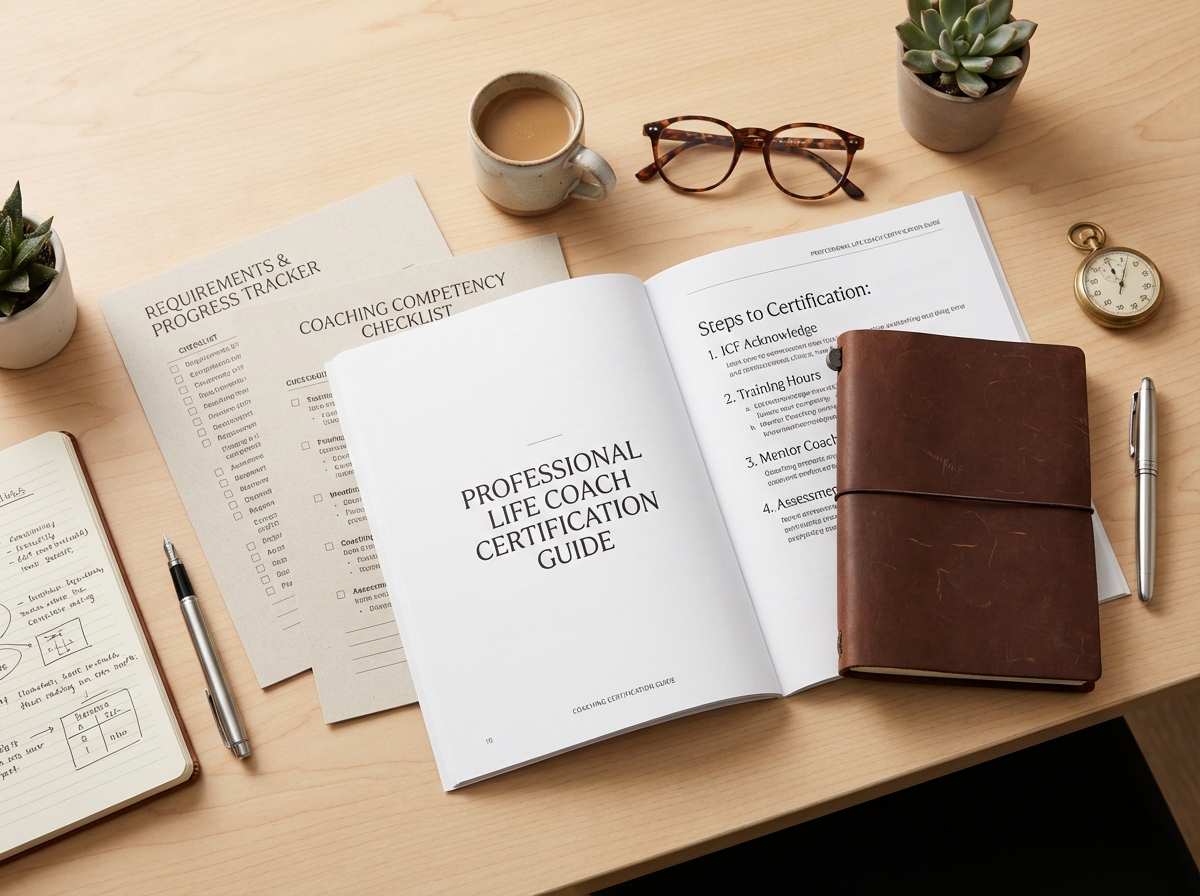
- 1.Life coach requirements are simpler than most people expect. No degree and no state license are needed in most of the U.S. because coaching is an unregulated profession.
- 2.ICF certification (the industry standard) requires 60+ hours of accredited training, 100+ coaching hours, 10 hours of mentor coaching, and passing the Coach Knowledge Assessment
- 3.You'll need a business license in most states to operate as a self-employed coach, plus a coaching agreement for every client
- 4.Professional liability insurance ($200-$500/year) isn't legally required in most cases but is strongly recommended

Professional Life Coach Certification
Foundational coaching certification covering methods, tools, and industry best practices.

Life Purpose Coach Certification
Help clients uncover purpose, align actions with values, and create meaningful lives.

Confidence Coach Certification
Help clients develop unshakable self-trust and overcome self-doubt.

NLP Coach Certification
Leverage NLP techniques to reprogram the subconscious for lasting transformation.
Affiliate link · We may earn a commission at no extra cost to you
Legal Requirements: What the Law Actually Says
The most common question about life coach requirements is whether you need a license. The short answer: no. No U.S. state currently requires a specific license to practice life coaching. Unlike therapy, which requires state licensure, coaching is an unregulated profession. Anyone can legally call themselves a life coach.
But "unregulated" doesn't mean "no rules." You still need to handle a few things:
A business license or registration. If you're running a coaching practice (and most coaches are self-employed), you'll need to register your business with your state. Requirements vary, but it usually means filing a DBA ("doing business as") or forming an LLC with your state's Secretary of State office.
Scope-of-practice boundaries. There's no coaching license to revoke, but coaches who cross into therapy territory (diagnosing conditions, treating mental illness) can face legal liability. Some states protect the titles "therapist" and "counselor" by law. If a coach oversteps, they could be charged with practicing without a license.
Tax compliance. Self-employed coaches pay estimated quarterly taxes, including self-employment tax (15.3% for Social Security and Medicare). You'll need an EIN from the IRS if you form a business entity.
Education Requirements
No degree is required to become a life coach. This is one of the biggest draws for career changers. You don't need to go back to school for a master's degree.
There are two exceptions:
NBHWC health coaching certification requires either an associate degree or higher, or 4,000 hours of documented work experience as an alternative (NBHWC).
CCE Board Certified Coach (BCC) requires a graduate degree in any field.
ICF certification, the most widely recognized coaching credential, has no degree requirement. It requires completing an ICF-accredited training program, which is professional education, not a university degree.
That said, background education in psychology, counseling, business, organizational development, or human resources can provide helpful context. Many successful coaches bring relevant professional experience from previous careers rather than specific educational credentials.
Training Requirements by Credential
No training is legally required to call yourself a coach. But professional certification requires specific training hours from accredited programs. Here's what each credential needs:
Training Requirements by Certification Level
| Credential | Training Hours | Coaching Experience | Mentor Coaching | Exam |
|---|---|---|---|---|
| ICF-ACC | 60+ hours (Level 1 program) | 100+ coaching hours | 10 hours (7 group, 3 individual) | Coach Knowledge Assessment |
| ICF-PCC | 125+ hours (Level 2 program) | 500+ coaching hours | 10 hours | Coach Knowledge Assessment |
| ICF-MCC | 200+ hours (Level 3 program) | 2,500+ coaching hours | 10 hours | Coach Knowledge Assessment |
| NBC-HWC | NBHWC-approved program | 50+ coaching sessions | Included in program | NBME Certifying Exam |
| BCC (CCE) | Graduate degree + coaching training | Varies | Varies | Written exam |
ICF training programs are accredited at three levels, which replaced the older ACTP and ACSTH designations. Level 1 prepares you for ACC, Level 2 for PCC, and Level 3 for MCC. Mentor coaching hours must be spread over at least 3 months.
For a complete overview of each credential, see our certification comparison guide.
Traditional ICF Programs
- Cost: $3,000–$15,000
- Duration: 6–12 months
- Schedule: Fixed class times
- Location: In-person or scheduled live
Transformation Academy
- Cost: $197
- Duration: Self-paced
- Schedule: Start anytime
- Location: 100% online
Affiliate link · We may earn a commission at no extra cost to you
ICF-ACC Certification: Step by Step
The most common path for new coaches is the ICF-ACC. Here's exactly what's required:
1. Complete 60+ hours of coach-specific training from an ICF-accredited Level 1 program. Programs range from $2,000-$4,000 and can be completed online or in-person in 2-6 months.
2. Log 100+ coaching experience hours. At least 75 hours must be paid coaching (25 can be pro bono). Start coaching clients while you're still in training.
3. Complete 10 hours of mentor coaching over at least 3 months: 7 hours group, 3 hours individual. Some programs include this. If yours doesn't, budget $1,000-$2,700.
4. Pass the Coach Knowledge Assessment (CKA). A written exam on ICF core competencies and ethics. The exam fee is included in your application.
5. Submit your application to ICF. Fee: $175 (ICF members) or $325 (non-members). Processing takes several weeks.
6. Maintain your credential. ICF credentials renew every 3 years. Renewal requires 40 hours of continuing education (24 in core competencies) and costs $175 (members) or $275 (non-members).
Business Requirements
Most coaches are self-employed, so you'll need to set up the business side properly:
Business structure. Most coaches start as a sole proprietorship or LLC. An LLC provides personal liability protection and is generally recommended. Filing fees vary by state ($50-$500).
Business license. Check with your city and county for local business license requirements. Many jurisdictions require one even for home-based businesses.
Professional liability insurance. Not legally required in most cases, but strongly recommended. It covers claims of negligence, harm, or breach of duty. Coaches pay $200-$500/year.
Client contracts. A coaching agreement should cover scope of services, fees, cancellation policies, confidentiality boundaries, and a clear disclaimer that coaching is not therapy.
For more on the business side, see our guide to starting a coaching business.
Skills You'll Need Beyond Certification
Life coach requirements go beyond credentials and paperwork. The coaches who build real practices develop these core skills:
Active listening. Coaching is at least 80% listening. You need to hear what your clients are saying and what they're not saying.
Powerful questioning. Open-ended questions that help clients think differently are your primary tool. ICF's core competencies are built around this skill.
Business acumen. Marketing, sales, networking, pricing, client management. If you can't find and keep clients, your coaching skills won't pay the bills.
Emotional intelligence. Managing your own reactions, reading your client's emotions, and navigating difficult conversations without crossing into therapy territory.
Boundary-setting. Knowing when you're coaching and when you're veering into therapy, advice-giving, or friendship. This protects both you and your clients.

Life Coaching 101
Free course on coaching foundations, processes, and best practices.
Affiliate link · We may earn a commission
Frequently Asked Questions
Sources
Official ICF credential requirements for ACC, PCC, and MCC
NBHWC health coaching certification education and experience requirements
BCC credential requirements including graduate degree prerequisite
Professional ethics standards and scope of practice guidance
Latest Articles

Life Coaching Industry Trends 2026
The coaching industry hit $5.34 billion. Here are the trends shaping 2026 and what they mean for new coaches.

How Much Does Certification Cost?
Complete cost breakdown: ICF-ACC, ICF-PCC, affordable alternatives from $197, and hidden costs nobody mentions.

Can ChatGPT Replace a Life Coach?
AI chatbots vs human coaches: effectiveness, cost, and what the research actually says.

Angela R.
Writer & Researcher
Angela has spent years walking alongside people through seasons of doubt, transition, and growth — guided by her Christian faith and a genuine calling to help others. She's witnessed firsthand the transformation that happens when someone gets the right support at the right time. That personal experience shapes every article here, grounded in real understanding of what it takes to help people through life's toughest moments.